Customs Clearance in the GCC: The File That Actually Clears (2026)
Direct answer
GCC customs clearance is won or lost before the vessel arrives. A complete file — correct HS code, CIF valuation, certificate of origin, conformity certificate and a licensed importer — clears in a few days. A file with one mismatch can sit for weeks. The broker matters, but the shipper controls the three variables that cause most delays: classification, valuation and certification.
Key facts
| Item | Position in late 2026 | Why it matters |
|---|---|---|
| Core documents | Invoice, packing list, B/L or AWB, certificate of origin, conformity certificate, insurance | A missing document stops the clock |
| Duty basis | CIF value | Freight and insurance are part of the duty base |
| Duty rate | GCC common tariff, often 5% | The HS line decides |
| VAT | 15% Saudi, 5% UAE, 5% Oman, 10% Bahrain, 0% Qatar/Kuwait | Charged on CIF plus duty |
| Inspection | Risk-based, physical or scanner | A query consumes free time |
| Free time | Typically a few calendar days from discharge | Clearance delays become storage costs |
| Importer | Licensed local entity | A foreign seller cannot be the importer in the ordinary sense |
| Single windows | Fasah (Saudi), Al Nadeeb (Qatar), emirate systems (UAE) | The declaration platform differs by country |
The clearance sequence
Clearance is a sequence, not an event. Understanding the sequence tells you where a shipment is stuck.
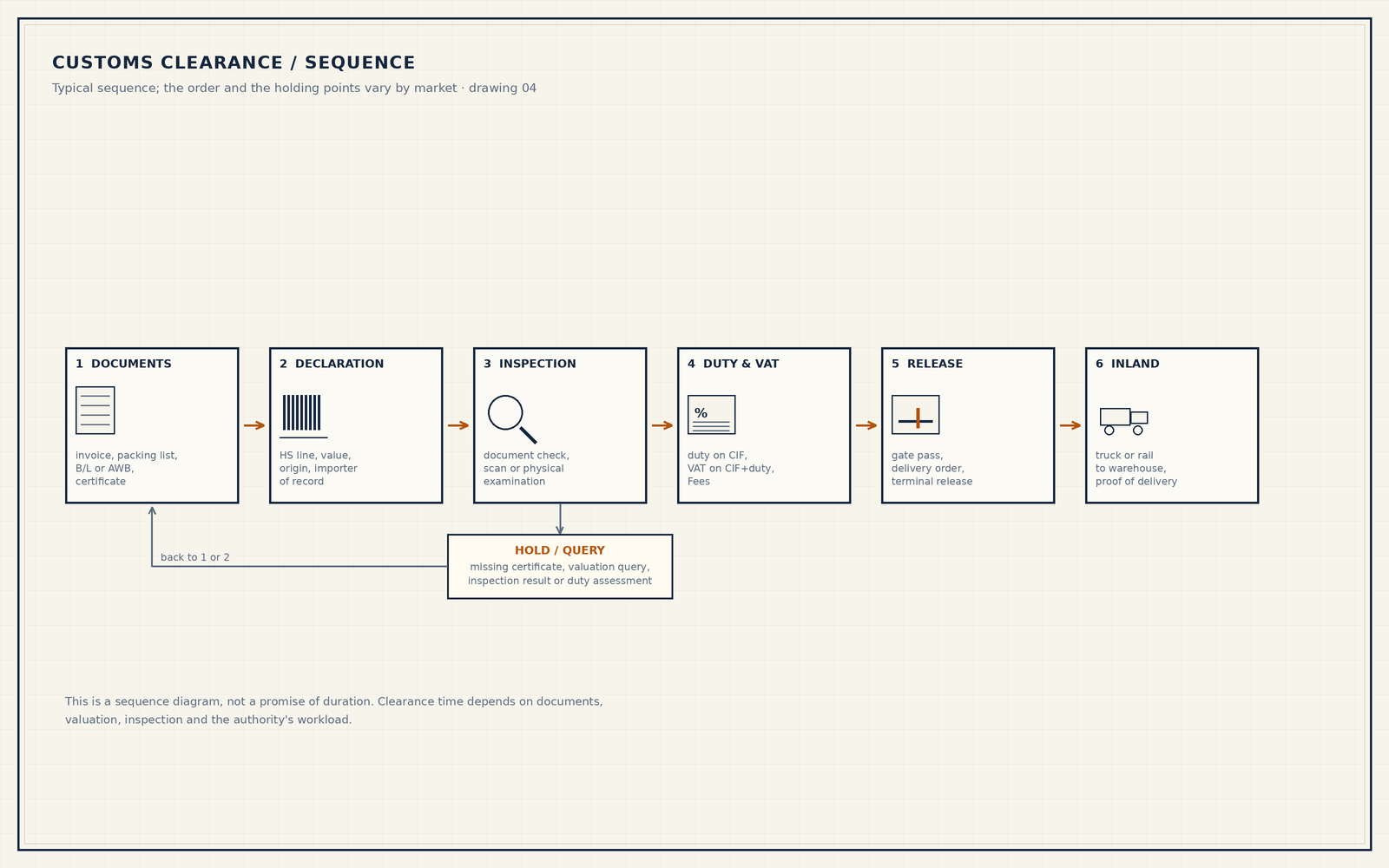
- Pre-arrival filing. The broker files the draft declaration before the vessel arrives, using the bill of lading, invoice and packing list. Errors caught here are cheap.
- Manifest and gate-in. The carrier files the manifest; the container is discharged and gated into the terminal. The free-time clock starts.
- Declaration submission. The broker submits the final declaration with the HS code, value, origin and documents.
- Risk assessment. The system routes the file to green (release), yellow (document review) or red (physical inspection).
- Duty and VAT payment. The importer or its broker pays the assessed duty and VAT.
- Release. Customs releases the container; the terminal issues a delivery order.
- Gate-out and delivery. The truck collects the container, and the empty is returned within the detention window.
Each step has an owner. The shipper owns the documents, the broker owns the filing, the importer owns the payment, and the terminal owns the gate. When a shipment is late, identify which step is holding it before blaming the port.
The core document file
A GCC import file usually contains:
- Commercial invoice — seller, buyer, description, quantity, unit price, total, Incoterm, origin, HS code where required.
- Packing list — packages, weights, dimensions, marks and numbers.
- Bill of lading or airway bill — the transport document, consignee, notify party, port of discharge.
- Certificate of origin — issued by a chamber of commerce or an authorised body, sometimes legalised.
- Conformity certificate — SABER PCoC/SCoC for Saudi Arabia, ECAS for the UAE, KUCAS for Kuwait, QGOSM for Qatar, and the national scheme for Oman and Bahrain.
- Insurance certificate — if the sale is CIF or the importer requires it.
- Import licence or registration — the importer's commercial registration and customs account.
- Sector approvals — SFDA for food and drugs in Saudi Arabia, Ministry of Public Health in Qatar, PAFN in Kuwait, Dubai Municipality in the UAE.
- Arabic labelling artwork — for food, cosmetics and many consumer products.
The most common document failure is not a missing document. It is a mismatch: the invoice says one quantity, the packing list says another; the certificate of origin names a different shipper; the conformity certificate covers a different model. Customs systems compare fields, and a mismatch triggers a query.
HS classification: the decision that sets the duty
The Harmonized System code determines the duty rate, the certification requirement and sometimes the import permit. It is the single most consequential field in the declaration.
Three rules of thumb:
Classify the product, not the marketing description. "Smart home hub" could be a computer, a radio receiver or a control panel. The tariff schedule describes products by function and material, not by brand.
Use the General Interpretative Rules. The GRI sequence — section notes, chapter notes, headings, subheadings — is the legal method. A classification that ignores the chapter notes is a guess.
Get a written opinion for high-value or ambiguous goods. Some customs authorities offer advance rulings. A ruling is not a guarantee for every shipment, but it is better than a broker's memory.
The cost of a wrong code is not only the duty difference. It can also be a certificate for the wrong category, a missing permit, or a penalty for misdeclaration. If the code changes after arrival, the shipment may need to be re-declared, and the free time may already be gone.
Valuation: why CIF matters
GCC customs values imports on a CIF basis: the price of the goods plus international freight plus insurance to the port of import. The declaration must show the relationship between the invoice price and the customs value.
The common errors:
- Quoting FOB and declaring FOB. The duty base is understated, and the correction adds duty plus a penalty.
- Excluding freight from the invoice. If freight is invoiced separately, it still forms part of the customs value.
- Related-party pricing. A transfer price between affiliated companies may be accepted, but it will be reviewed. Keep the comparables.
- Royalties and assists. Payments for patents, trademarks or tooling can be dutiable if they are a condition of sale.
- Warranty and service contracts. Separately invoiced service is usually not dutiable, but bundled service can be.
A valuation query is not a disaster if the file supports the declared value. It becomes a disaster when the importer cannot produce the payment evidence, the contract and the freight invoice.
Inspection and release
Customs risk engines route declarations to different channels. A green channel releases on documents; a yellow channel reviews documents; a red channel requires a physical inspection.
The inspection is a finite resource. A scanner can process a container in minutes; a physical unpack can take hours. During a surge, the queue for a red-channel inspection can be days.
What reduces the probability of a red channel:
- A clean declaration history for the importer and the broker.
- A precise product description and a consistent HS code.
- A complete conformity certificate.
- An invoice value that is consistent with the product and the market.
- A certificate of origin that matches the shipment.
What does not help: a lower invoice, a vague description, or a last-minute change of consignee.
Free time, storage and demurrage
Free time is the period after discharge during which the container can stay at the terminal without storage charges. It is usually a few calendar days, and it is consumed by clearance, not by sailing.
The cost ladder:
- Storage — charged by the terminal after free time, per container per day.
- Demurrage — charged by the carrier for the container staying at the terminal beyond the agreed period.
- Detention — charged by the carrier for the container staying outside the terminal beyond the agreed period.
- Relocation — charged when the terminal moves an uncleared container to free the yard.
The cheapest way to manage these costs is to file before arrival. The second cheapest is to know the free-time terms in writing. The most expensive is to assume that "free time" means until you are ready.
Country differences that matter
Saudi Arabia. Fasah is the single window. SABER is the conformity platform. ZATCA administers customs and VAT. The importer needs a Saudi commercial registration. SABER PCoC and SCoC are separate documents, and the SCoC is shipment-specific.
UAE. Customs is administered at emirate level. Dubai Customs, Abu Dhabi Customs and Sharjah Customs have separate systems and broker registrations. A Dubai licence does not automatically cover an Abu Dhabi import. Free zones are separate customs territories in practice.
Qatar. Al Nadeeb is the single window. The importer needs a Qatari commercial registration. There is no VAT. QGOSM administers conformity.
Kuwait. Kuwait Customs administers clearance. KUCAS is the conformity scheme. The commercial agency law can determine who is allowed to import a product. There is no VAT.
Oman. Oman Customs administers clearance through its electronic system. VAT is 5%. Sohar and Salalah have different hinterlands and different broker pools. The UAE border at Al Buraimi is a separate customs flow.
Bahrain. Bahrain Customs administers clearance. VAT is 10%. The King Fahd Causeway to Saudi Arabia is a separate customs border; a Bahrain import and a Saudi transit are different declarations.
Choosing a broker: ten questions
A good broker is not the cheapest. It is the one who files at your port weekly and tells you when the file is wrong.
- How many declarations did you file at this port last month?
- Which single window do you use, and what is your average release time?
- Have you handled this HS chapter before?
- What conformity certificate does this product need, and who issues it?
- What is the free-time allowance at this terminal, and who pays storage?
- Can you file before the vessel arrives?
- What is your fee, and what is excluded?
- Who pays duty and VAT, and how is the payment evidenced?
- What happens if the container is selected for inspection?
- Can you give two references from importers in my product category?
If the broker cannot answer questions 3 to 5, the relationship is a transaction, not a service.
Failure modes and fixes
Wrong HS code. Fix: classify before booking, get a written opinion for ambiguous goods. Understated value. Fix: declare CIF honestly, keep payment and freight evidence. Missing conformity certificate. Fix: start the certificate process before production, not before sailing. Importer mismatch. Fix: confirm the importer's registration and licence activity before the booking. Late filing. Fix: send the draft documents to the broker as soon as the bill of lading is issued. Storage surprise. Fix: get the free-time terms in writing and diarise the expiry. Inspection queue. Fix: build a buffer into the delivery promise; do not promise a date you cannot control.
The 48-hour pre-arrival review
The single most useful habit in GCC clearance is a 48-hour pre-arrival review. Two working days before the vessel berths, the shipper, the broker and the importer should confirm six things:
- The bill of lading is issued and the consignee is correct. A last-minute change of consignee is a last-minute change of importer, and it can invalidate the certificate.
- The invoice and packing list match. Quantity, weight, description and HS code should be consistent across both documents.
- The certificate is valid for the shipment. PCoC, SCoC, ECAS, KUCAS or QGOSM, as applicable.
- The importer's registration covers the product. The licence activity and the customs account must match.
- The duty and VAT funding is in place. A payment delay at the assessment stage is a storage delay.
- The delivery slot is booked. The truck and the warehouse should be ready before release, not after.
The review takes under an hour and prevents most of the failures described on this page. It also gives the broker a clean file to submit as soon as the manifest is available, which is the difference between a two-day and a five-day release.
The review should be documented, not verbal. A one-page checklist with the six items, the responsible person and the date is enough. When a shipment goes wrong, the checklist shows whether the file was clean before arrival or whether the gap was created at the port.
Our read
Customs clearance is the part of freight that rewards boring discipline. The shippers with the fewest delays are not the ones with the best contacts; they are the ones with a complete file, a consistent HS code and a broker who files early.
The GCC is not a single customs market. The single windows differ, the conformity schemes differ, the VAT rates differ and the importer rules differ. A broker who is excellent in Dubai may be average in Dammam. Match the broker to the port, and match the file to the country.
FAQ
How long does customs clearance take in the GCC? With a complete file, two to five working days is common. With a certificate or valuation query, one to three weeks. The range depends on the country, the port and the product.
What documents do I need to clear customs? Invoice, packing list, bill of lading or airway bill, certificate of origin, conformity certificate, insurance certificate and the importer's registration. Sector approvals may be additional.
Can I clear customs without a local importer? Not in the ordinary sense. The importer of record must be a licensed local entity. A DDP structure uses a local importer, but the liability and the VAT treatment must be agreed.
What is CIF valuation? The customs value based on the goods price plus international freight plus insurance to the port of import.
Why is my container in inspection? The risk engine selected it. Common triggers are a new importer, an unusual product, a value query or a missing certificate. A broker cannot override the selection.
Who pays storage and demurrage? Usually the party that caused the delay, but the terminal and carrier charge the container's counterparty. The contract should allocate the cost.
Is a customs broker the same as a freight forwarder? Not always. A forwarder may arrange transport and sub-contract the brokerage. Confirm who files the declaration and who is licensed at the port.
Sources and update log
- Saudi Customs (ZATCA) — https://zatca.gov.sa/
- Fasah single window — https://www.fasah.sa/
- SABER — https://saber.sa/
- UAE Federal Customs Authority — https://www.fca.gov.ae/
- Dubai Customs — https://www.dubaicustoms.gov.ae/
- Qatar Customs, Al Nadeeb — https://www.customs.gov.qa/
- Kuwait Customs — https://www.customs.gov.kw/
- Oman Customs — https://www.customs.gov.om/
- Bahrain Customs — https://www.customs.gov.bh/
- World Customs Organization, HS nomenclature — https://www.wcoomd.org/
Update log. 11 November 2026: first publication. Covers the clearance sequence, documents, HS classification, CIF valuation, free time and the six GCC customs regimes. Next review: 11 January 2027.
Method note: our research conventions are documented in methodology. This is an operational guide, not legal advice.
Related reading
- DDP guide — who is the importer
- Certification guide — conformity schemes
- Cost and transit guide — quote anatomy
- China → Saudi route — Fasah and SABER
- China → UAE route — emirate systems
- China → Qatar route — Al Nadeeb
- China → Kuwait route — KUCAS
- China → Oman route — Sohar and Salalah
- China → Bahrain route — causeway
- DDP vs self-clearance — the decision
- Jeddah vs Dammam — port choice
- FCL guide — container economics
- LCL guide — consolidation
- Batteries sector — DG documentation
- Chemicals sector — SDS and permits
- About Freighthub — editorial standards
- Corrections — how we fix errors
In our view
We would spend the effort on classification, valuation and certification before the vessel sails, and choose a broker who files weekly at the actual port of entry. The page's evidence is that the shippers with the fewest delays are the ones with complete, consistent files rather than the best contacts, and that a broker strong in one port may be average in another. The exception is a genuinely novel product whose tariff treatment is unsettled; there, an early ruling is worth more than any amount of file polish.
Document matrix: issuer, timing, and what breaks
The core-file list above says what belongs in the file. This matrix says who produces each document, the step in the sequence where it is read, and what its absence does to the shipment. Step numbers refer to the seven-step sequence above.
| Document | Who issues it | When it is needed | If it is missing |
|---|---|---|---|
| Commercial invoice | Seller | Pre-arrival filing, step 1 | No price and no HS line to declare; the declaration cannot be lodged |
| Packing list | Seller | Pre-arrival filing, step 1; re-read at inspection, step 4 | Quantity and weight cannot be reconciled against the invoice, and the mismatch triggers a query |
| Bill of lading or airway bill | Carrier or forwarder | Pre-arrival filing, step 1 | No transport document and no confirmed consignee; filing cannot start |
| Certificate of origin | Chamber of commerce or authorised body, sometimes legalised | Declaration submission, step 3 | The origin field is unsupported and the declaration is incomplete |
| Conformity certificate — SABER PCoC and SCoC, ECAS, KUCAS, QGOSM or the national scheme | Accredited conformity body, registered with the national regulator | SCoC before arrival; PCoC before production | Cargo cannot be cleared. The only fixes are to obtain the certificate or to re-export |
| Insurance certificate | Insurer | Declaration submission, step 3, when the sale is CIF or the importer requires it | The CIF value is unsupported at a valuation query |
| Import licence and customs registration | The importer's licensing authority, and the customs administration for the customs account | Before the first declaration under that importer | No importer of record; nothing can be filed under the consignee's name |
| Sector approval — SFDA, Ministry of Public Health in Qatar, PAFN in Kuwait, Dubai Municipality | The sector regulator | Before release of the affected lines, step 6 | Release is held for those lines whatever the customs file says |
| Arabic labelling artwork | Shipper or manufacturer | Before the labels are printed; checked at inspection, step 4 | A label gap surfaces as a query while free time is already running |
| Freight invoice and payment evidence | Forwarder or carrier; the importer's bank | At a value query in step 4, and before release in step 6 | The declared CIF cannot be defended, and a correction adds duty plus a penalty |
Read the "when" column as a deadline, not a schedule. The file is read at step 1 and step 3, which is the argument for the 48-hour review further down: by the time the container is at the gate, the only document work left is fixing what was wrong.
Worked example
Six SKUs, one container, Jeddah, two of the SKUs regulated. The arithmetic counts document lines, not pages: a document issued once counts once, whatever its length.
Assumptions. One commercial invoice, one packing list, one bill of lading, one certificate of origin, one insurance certificate because the sale is CIF, and one importer with a valid commercial registration and customs account. SKUs 1 and 2 are electrical appliances covered by a SASO technical regulation; SKUs 3–6 are assumed outside the regulated categories, to be confirmed against the HS code. Each regulated SKU is its own product family, so each needs its own PCoC. All figures below are counts of documents, not fees.
Arithmetic.
- Consignment-level lines: invoice 1 + packing list 1 + bill of lading 1 + certificate of origin 1 + insurance 1 + importer registration 1 = 6. These do not change with the number of SKUs.
- SKU-level lines: one PCoC per regulated family × 2 = 2, plus one SCoC per shipment = 1, so 3.
- Total for this shipment: 6 + 3 = 9 document lines for 6 SKUs. Three of the nine cover 2 SKUs; six cover the consignment as a whole.
- If the two SKUs were one family under one regulation: 6 + 1 + 1 = 8 lines. One family decision removes one document line and one test programme.
- Four shipments in a year on still-valid PCoCs: 6 × 4 = 24 consignment-level lines, plus 2 PCoC, plus 4 SCoC = 30. Rebuilding the product certificates each time would be 9 × 4 = 36. The difference of 6 is the PCoC set reissued three times.
How the sequence changes. With six unregulated SKUs the file is complete at step 1 and the sequence runs straight through. With two regulated SKUs, step 3 cannot be submitted until the SCoC exists, and the SCoC cannot be issued until a PCoC covers the exact model and the correct importer is registered. So steps 3, 4, 5, 6 and 7 queue behind one document — five of the seven steps. The free-time clock started at step 2 regardless, which is why the delay is measured from gate-in rather than from the day the certificate arrives. And if SKU 2 lands in a variant the PCoC does not name, the count stays at 9 lines while the certificate covers 1 of the 2 regulated SKUs: the file is one document short of clearable, and no broker can close that gap.
Related
Jeddah carries the terminal, free-time and hinterland detail behind step 2 of the sequence. DDP vs self-clearance and the DDP guide settle who is the importer of record before the file is built, which decides whose registration appears on the declaration. For the country layer, Saudi Arabia and the UAE give the registration, single-window and emirate rules for the two largest GCC markets.